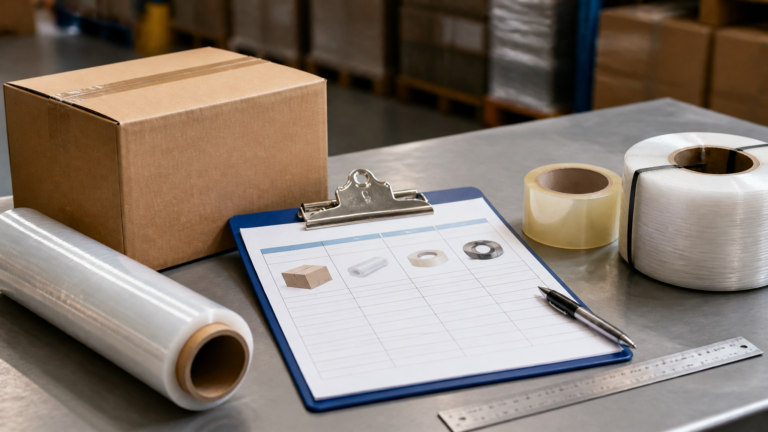
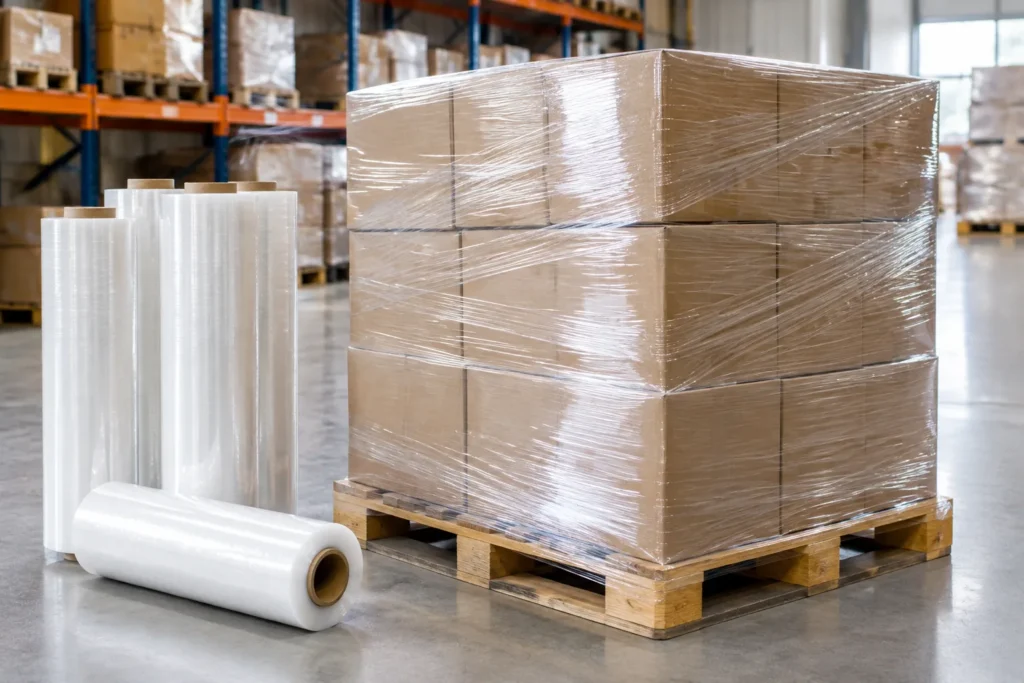
If you are buying pallet wrap, you will eventually run into two terms: cast stretch film and blown stretch film. They look similar on a pallet, but the way they are made changes their clarity, cost, strength, and how they behave on your wrapping line.
The short answer: choose cast stretch film when you want maximum clarity, quieter unwind, and a lower cost per roll for uniform loads. Choose blown stretch film when you need higher puncture and load-holding strength for heavy, sharp, or irregular loads — and you are willing to pay a little more for it.
What Is the Difference Between Cast and Blown Stretch Film?
Both are made from linear low-density polyethylene (LLDPE), but the manufacturing process is different:
- Cast stretch film is extruded through a flat die onto a chilled roller. The fast cooling locks in clarity and produces a film with a consistent thickness and a quiet, smooth unwind.
- Blown stretch film is extruded through a circular die and inflated with air into a bubble before being cooled and flattened. The slower cooling makes the film hazier but gives it a tougher, more puncture-resistant structure.
Cast vs Blown Stretch Film: At a Glance
| Factor | Cast Stretch Film | Blown Stretch Film |
|---|---|---|
| Clarity | Crystal clear | Hazy / milky |
| Cost per roll | Lower | Higher |
| Unwind noise | Quiet, smooth | Louder |
| Tear resistance | Higher | Lower |
| Puncture resistance | Good | Better |
| Load-holding on irregular loads | Good | Better |
| Cling consistency | Very consistent | Slightly less consistent |
| Best for | Uniform loads, high volume, cost control | Heavy, sharp, or irregular loads |
When Cast Stretch Film Makes Sense
You Want Clear, Professional-Looking Pallets
Cast film lets barcode scanning and load identification happen through the wrap, which is why it is the default choice for retail and distribution environments.
You Wrap a High Volume of Uniform Loads
Because cast film unwinds quietly and consistently, operators can wrap faster with less fatigue, and the lower roll cost keeps cost per pallet down.
When Blown Stretch Film Makes Sense
Your Loads Have Sharp Corners or Irregular Shapes
Blown film’s higher puncture resistance and “memory” (its ability to snap back and hold tension) make it the safer choice for machinery parts, lumber, and heavy mixed pallets.
You Need Maximum Load Stability on Long Hauls
For loads that travel long distances or get handled multiple times, blown film’s stronger load-holding helps the pallet stay intact.
How to Choose the Right Stretch Film
- Look at your typical load: uniform and boxy, or heavy and irregular?
- Decide whether clarity matters (barcode scanning, branding through the wrap).
- Compare total cost per pallet, not just cost per roll.
- Test both types on your own wrapping equipment before committing to a volume.
Frequently Asked Questions
Is cast or blown stretch film stronger?
Blown stretch film generally has higher puncture and load-holding strength, while cast film has higher tear resistance along its edge. The “stronger” film depends on what kind of damage your loads actually face.
Why is cast stretch film cheaper than blown?
The cast extrusion process runs faster and uses a simpler cooling method, so cast film is less expensive to produce, and that saving is passed through in the roll price.
Can I use cast and blown stretch film on the same machine?
Yes. Both are compatible with standard hand dispensers and pallet-wrapping machines. The main practical difference you will notice is unwind noise and how the film feels.
Is cast stretch film clear or cloudy?
Cast stretch film is crystal clear. Blown stretch film has a hazy, milky appearance because of its slower air-cooling process.
Which type clings better?
Both use LLDPE’s natural cling. Cast film tends to deliver more consistent, even cling across the roll, while blown film can feel tackier but slightly less uniform.
Does blown stretch film stretch more?
Blown film typically has a higher ultimate stretch percentage and stronger load-holding, but cast film pre-stretches more smoothly on machine lines. The right choice depends on whether you prioritize stretch distance or holding force.
What type does RX Packaging recommend for first-time buyers?
For most uniform pallet loads, RX Packaging recommends starting with cast stretch film for its clarity and cost control, then switching to blown film if you see punctures or load failures on irregular loads.
Choosing a Stretch Film Supplier
The film type matters, but so does the manufacturer behind it. RX Packaging has produced packaging consumables since 2007, with stretch film among its core products. Every batch runs through a 12-point inspection covering tension, corrosion resistance, and elasticity, and the company is SGS-certified from its Foshan, China facility. It supplies both transparent LLDPE pallet stretch film and colored stretch film for load identification and tamper-evident applications, plus hand stretch film and machine-grade stretch film.
Need help deciding between cast and blown stretch film for your specific loads? Contact RX Packaging for a tailored recommendation and quote.