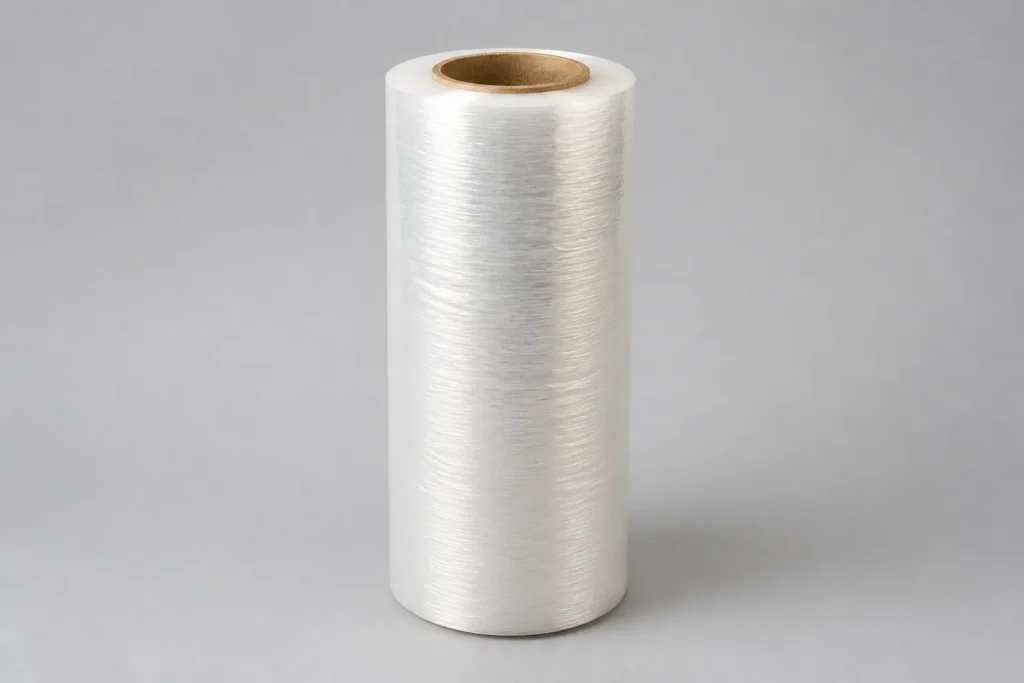
Stretch Film Thickness Gauge: How to Specify the Right Micron
Stretch film thickness gauge is the nominal caliper of the film, usually quoted in microns or mils, and it is the number buyers cite most often and understand least. Thickness sets how much material protects the load, but stretch ratio, resin quality and gauge consistency decide what that material actually does. A thin film with tight tolerance can beat a thick film with thin spots. This guide helps buyers decide which gauge to specify, how to verify it and when downgauging is safe.
1. What does stretch film thickness gauge actually measure?
Stretch film thickness gauge measures nominal caliper across the web, normally in microns, with one mil equal to about 25.4 microns. The figure on the carton is an average, not a guarantee that every centimetre matches. Two rolls at the same nominal gauge behave differently if one has a wider thickness spread. Ask for a thickness profile rather than a headline number.
| Dimension | Impact | Buyer action / evidence |
|---|---|---|
| Nominal micron | Roll mass and strength | Compare quotations |
| Gauge profile | Break risk | Request thickness map |
| Unit confusion | Wrong grade ordered | Confirm micron on PO |
2. How does stretch film thickness gauge affect strength?
Stretch film thickness gauge raises tensile capacity in a roughly linear way, but puncture and tear resistance depend more on resin and structure than on caliper. Doubling thickness does not double puncture performance, and trimming thickness does not always reduce it. That gap is where good film engineering creates savings. Test puncture and tear at the gauge you plan to buy.
| Dimension | Impact | Buyer action / evidence |
|---|---|---|
| Tensile strength | Containment force | Tensile test report |
| Puncture | Corner damage | Dart impact result |
| Tear | Failure propagation | Tear resistance data |
3. How does stretch film thickness gauge affect cost per pallet?
Stretch film thickness gauge drives cost per pallet through kilos consumed, and the relationship is not as direct as buyers expect. A thinner film stretched to its limit may use less resin but break more often, while a slightly thicker film at moderate stretch delivers steadier output. Cost per pallet combines price, kilos used and failure rate. Calculate on delivered metres, not roll weight alone.
| Dimension | Impact | Buyer action / evidence |
|---|---|---|
| Gauge | Kilos consumed | Consumption trial |
| Stretch ratio | Metres per kilo | Wrapper settings |
| Break rate | Rework and downtime | Shift break log |
4. Which stretch film thickness gauge suits which load weight?
Stretch film thickness gauge should follow load weight and edge risk, because a light stable pallet and a heavy pallet with hard corners need different film mass. Light loads tolerate thinner film with high stretch, while heavy or irregular loads need more thickness or a tougher structure. Build a simple weight-based specification matrix. Give it to your supplier as a written brief.
| Dimension | Impact | Buyer action / evidence |
|---|---|---|
| Load weight | Containment required | Weight per pallet data |
| Load shape | Bridging need | Pallet photos |
| Edge risk | Puncture exposure | Corner inspection |
5. How should a buyer verify stretch film thickness gauge on delivery?
Buyers should verify stretch film thickness gauge with a micrometer at several points across the web and along the roll, then compare average and spread with the specification. A single reading proves nothing. Record measurements in a receiving log and raise deviations immediately. Consistent verification turns a nominal promise into a managed specification.
| Dimension | Impact | Buyer action / evidence |
|---|---|---|
| Measurement points | Detects gauge bands | Ten-point reading sheet |
| Average value | Confirms nominal gauge | Receiving log |
| Spread | Predicts break risk | Tolerance comparison |
6. When is downgauging stretch film thickness gauge safe?
Downgauging stretch film thickness gauge is safe when puncture resistance holds, the wrapper controls pre-stretch precisely and loads have no sharp edges. Downgauging fails when buyers cut gauge without changing resin or structure. Move one step at a time and monitor damage for at least a month. Never downgauge an export lane without a transit trial.
| Dimension | Impact | Buyer action / evidence |
|---|---|---|
| Gauge step | Manageable risk | Staged trial plan |
| Resin quality | Strength at low mass | Material specification |
| Transit result | Confirmed safety | Damage report |
7. How does stretch film thickness gauge interact with pre-stretch?
Stretch film thickness gauge and pre-stretch interact because thin film reaches its elongation limit sooner and breaks, while thick film absorbs more stretch before failing. The wrapper setting must match both gauge and resin. Matching them well cuts kilos per pallet without raising damage. Ask for a recommended setting range per gauge.
| Dimension | Impact | Buyer action / evidence |
|---|---|---|
| Elongation limit | Break point | Elongation test data |
| Pre-stretch setting | Film usage | Wrapper parameter sheet |
| Applied force | Necking and tears | Wrapping observation |
8. What should a buyer request before ordering a stretch film thickness gauge?
Before ordering a stretch film thickness gauge, buyers should request a grade-specific specification listing nominal micron, tolerance, width, length and core size, plus a sample roll to measure. Confirm how gauge is controlled in production and which checks are recorded. Ask whether the same gauge is available in cast and blown. Put tolerance in writing on the purchase order.
| Dimension | Impact | Buyer action / evidence |
|---|---|---|
| Tolerance | Acceptable variation | Written specification |
| Width and length | Delivered area | Roll label data |
| Structure options | Performance at gauge | Cast and blown samples |
Frequently Asked Questions
Q1. Is 20 micron stretch film strong enough?
Twenty micron film can be strong enough for light, stable pallets when resin and structure are good and pre-stretch is controlled. It is rarely enough for heavy loads with sharp corners, so test on your own pallets.
Q2. How many microns is a mil of stretch film?
In stretch film thickness gauge terms, one mil equals about 25.4 microns, so 80 gauge film is roughly 20 microns. Confirm whether a quotation uses mils or microns to avoid ordering the wrong thickness.
Q3. Does thicker stretch film always hold a pallet better?
Thicker film adds mass and tensile capacity, but containment also depends on stretch, overlap and pattern. A well-applied thin film can outperform a badly applied thick film.
Q4. Why does my film measure thinner than the label?
Film can measure thinner if the roll sits at the low end of tolerance, if the micrometer is wrongly zeroed, or if the film is measured after stretching. Calibrate and measure at several points.
Q5. Can RX Packaging supply the same gauge in cast and blown film?
Yes, RX Packaging produces both cast and blown stretch film, so buyers can compare the same nominal thickness across structures and keep the one that survives their loads.