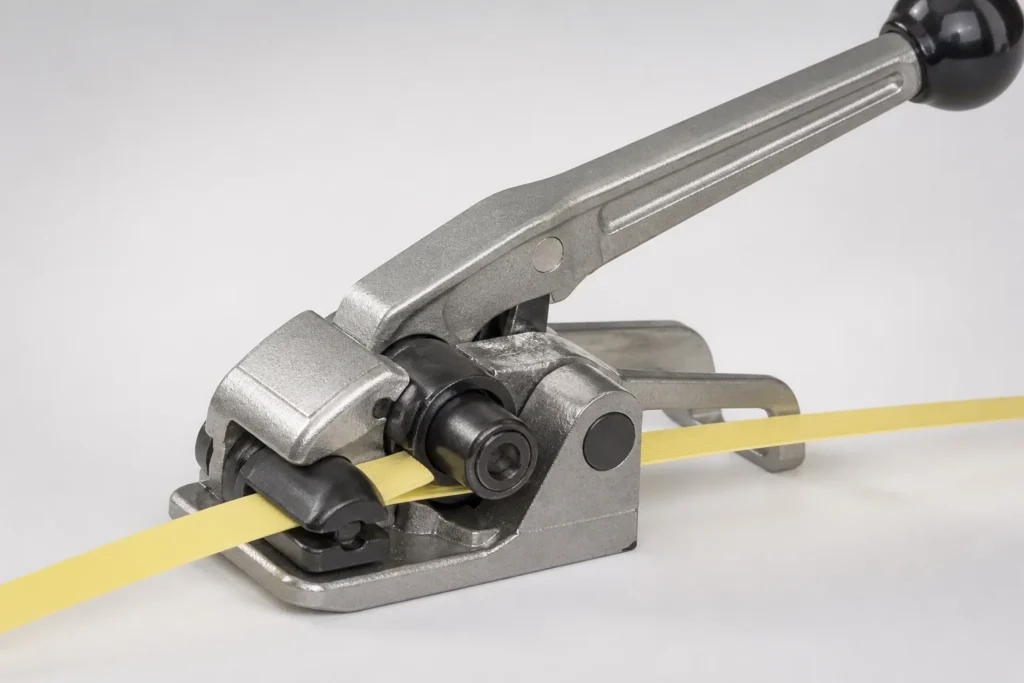
Hand vs Machine Strapping: Which Tool Fits Your Line?
Hand vs machine strapping is decided by volume, repeatability and labour, not by tool price. Hand tools give flexibility on mixed, low-volume benches; machine systems deliver consistent tension and seals at high throughput. Most plants eventually need both. Choosing wrongly shows up as idle capital or exhausted operators. This guide helps buyers decide where hand tools stop paying and a machine starts earning, using their own pallet count and seal data.
1. What is the real difference between hand vs machine strapping?
Hand vs machine strapping differs in who supplies tension and how the seal is made. With hand tools an operator feeds, tensions and seals each band; with a machine, a semi-automatic or arch system tensions, seals and cuts to a set programme. The real difference is repeatability, because operators vary and machines do not.
Measure your daily pallet count before comparing tool prices.
| Dimension | Impact | Buyer action / evidence |
|---|---|---|
| Tension source | Manual versus programmed | Compare tension consistency samples |
| Seal method | Metal, friction or heat | Inspect seal strength on both |
| Mobility | Hand tools travel to loads | Map load positions on the floor |
2. How does hand vs machine strapping change cycle time and labour?
Hand vs machine strapping changes labour more than any other factor. A hand cycle includes walking, feeding, tensioning, sealing and trimming, so output stays low and fatigue builds. A machine compresses those steps into seconds and frees the operator to position loads. The gap widens with pallet size and strap count.
Time ten pallets by hand and by machine before deciding.
| Dimension | Impact | Buyer action / evidence |
|---|---|---|
| Cycle time | Labour cost per pallet | Stopwatch ten pallets per method |
| Strap count | Manual handling load | Count straps on the heaviest SKU |
| Shift length | Seal quality drift | Audit seals at shift start and end |
3. Where does hand vs machine strapping each fit on a packing floor?
Hand vs machine strapping fits different geography inside the plant. Hand tools belong at repair benches, sample areas and docks where loads arrive irregularly. Machines belong at the end of a fixed line or a palletizer where every load looks the same. Placing a machine where sizes vary creates jams and idle time.
Draw the material flow and mark where load size becomes predictable.
| Dimension | Impact | Buyer action / evidence |
|---|---|---|
| Load variety | Flexibility requirement | Record size changes per shift |
| Layout | Travel distance kills output | Sketch flow from line to dock |
| Backup | Downtime risk | Keep a hand tool at each station |
4. Which hand vs machine strapping setup suits low, medium and high volume?
Hand vs machine strapping should scale with volume bands, not ambition. Low volume under a few dozen pallets a day rarely justifies a machine. Medium volume with stable sizes usually pays back on a semi-automatic unit. High volume across multiple shifts makes an automatic arch the only sensible choice.
Set volume bands in pallets per shift and assign a tool to each.
| Dimension | Impact | Buyer action / evidence |
|---|---|---|
| Pallets per shift | Payback driver | Count output for four weeks |
| Size stability | Automation needs repeatability | Measure size variation by SKU |
| Shifts per day | Capital utilisation | Multiply volume by shifts |
5. How should a buyer choose hand vs machine strapping for seasonal peaks?
Hand vs machine strapping decisions often break at seasonal peaks, when volume triples for a few weeks. Buying a machine for a short peak ties up capital all year, while hand tools alone exhaust staff and slow dispatch. A semi-automatic unit plus trained temporary operators is the usual answer.
Model your peak month, not your average month.
| Dimension | Impact | Buyer action / evidence |
|---|---|---|
| Peak ratio | Idle capital in low season | Chart monthly volume for a year |
| Labour supply | Peak hiring quality | Pre-train a standby team |
| Ramp-up | Machine lead time | Order before the season starts |
6. What should you check on hand vs machine strapping tools before buying?
Hand vs machine strapping tools fail on small details: tool weight, strap path, seal quality and spare parts. Ask for a demonstration on your own cartons and bands, then run a full coil through the tool. Check how quickly a jam clears, because repeated jams erase any speed gain.
Demand a trial on your strap, not the supplier sample.
| Dimension | Impact | Buyer action / evidence |
|---|---|---|
| Tool weight | Fatigue and drop damage | Hold the tool for ten minutes |
| Feed reliability | Jams stop the line | Run a full coil on real cartons |
| Spare parts | Downtime length | Request a spare parts list |
7. How does hand vs machine strapping affect strap consumption and seal quality?
Hand vs machine strapping consumes strap differently. Operators add extra length for handling and over-tension soft loads, so hand sealing often wastes band. Machines cut to a set length and apply repeatable tension, which lowers consumption and stabilises seal quality cycle after cycle.
Weigh strap consumption per hundred pallets for each method.
| Dimension | Impact | Buyer action / evidence |
|---|---|---|
| Strap length | Direct material cost | Weigh coils per hundred pallets |
| Tension setting | Carton crush and loosening | Inspect cartons after tensioning |
| Seal repeatability | Failure and rework rate | Pull-test ten seals per shift |
8. Should a growing plant buy hand vs machine strapping first?
Buy hand tools first when volume is low or sizes vary, because they protect cash and stay useful as backup. Buy a machine first when one line already runs high, stable volume, since manual sealing becomes the bottleneck and the quality risk. Many plants end with both, which is a rational result.
Start with the constraint, then spend to remove it.
| Dimension | Impact | Buyer action / evidence |
|---|---|---|
| Bottleneck | Spending in the wrong place | Identify the slowest step |
| Cash flow | Tool cost versus payback | Calculate months to payback |
| Flexibility | Future SKU changes | Keep at least one manual option |
Q1. Is hand vs machine strapping only about speed?
No. It also changes seal consistency, strap consumption and operator fatigue. Speed is visible, but repeatability and material waste usually decide payback.
Q2. Can a semi-automatic machine replace hand tools completely?
Rarely. Hand tools still earn their place at repair benches and irregular loads. Most plants keep one tensioner and sealer per station as backup.
Q3. How much space does hand vs machine strapping need?
Hand tools need only bench or floor space, while machines need a fixed footprint plus load clearance. An arch machine also needs a straight approach, so check aisle width first.
Q4. Which option suits mixed carton sizes?
Hand tools handle mixed sizes better because the operator adapts each time. Machines prefer repeatable sizes, so keep mixed SKUs on a manual bench or use semi-automatic equipment.
Q5. What should I request before buying strapping tools?
Ask for a trial on your cartons and bands, a spare parts list and seal strength samples from a full coil run. RX Packaging supplies matched band so tool and consumable are tested together.