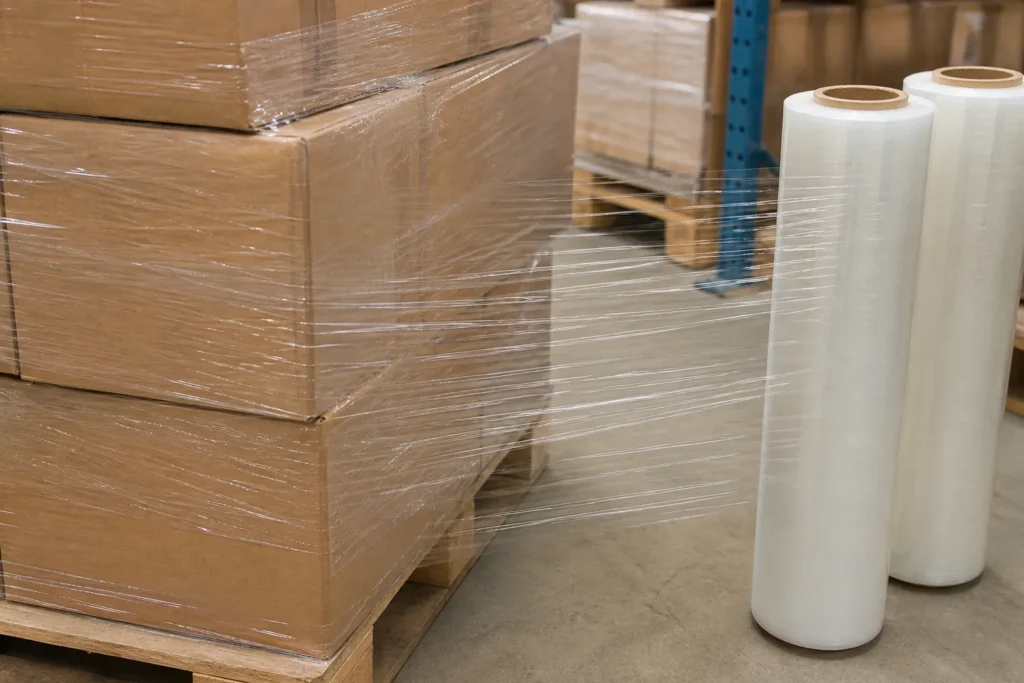
How to Calculate Stretch Film per Pallet (With a Worked Method)
Calculate stretch film per pallet by multiplying film length per revolution by the number of revolutions, dividing by stretch ratio, then converting that length into weight using width, gauge and polyethylene density. The result gives kilos per pallet, the number that drives cost and procurement planning. Most buyers guess this figure and then wonder why consumption drifts. This guide helps buyers decide how to measure, calculate and audit film usage per pallet.
1. What is the formula to calculate stretch film per pallet?
Calculate stretch film per pallet in three steps: length per revolution, times revolutions, divided by stretch ratio, then converted to weight. Length per revolution is the pallet perimeter plus overlap allowance. Dividing by stretch ratio accounts for elongation during application. Write the formula on the wrapper log so operators can see it.
| Dimension | Impact | Buyer action / evidence |
|---|---|---|
| Perimeter | Base film length | Tape measure record |
| Revolutions | Total wrap length | Wrapper cycle count |
| Stretch ratio | Film consumed | Machine setting log |
2. How do you measure pallet perimeter to calculate stretch film per pallet?
Measure pallet perimeter by adding length and width, doubling the result, then adding corner overlap and any width lost to necking. Overlap is usually a percentage of film width, so wider film covers more per revolution at the same percentage. Measure three pallets rather than one, because cartons bulge. Record the average in your calculation sheet.
| Dimension | Impact | Buyer action / evidence |
|---|---|---|
| Perimeter | Film length per turn | Measured average |
| Overlap percentage | Coverage and strength | Written wrap standard |
| Film width | Turns needed | Specification sheet |
3. How do you count revolutions to calculate stretch film per pallet?
Count revolutions by watching one full wrap cycle and noting how often the film crosses a fixed point, or by reading the count from the wrapper’s cycle log. For hand wrapping, count three pallets manually. Revolutions rise with load height and overlap percentage. A small change in revolutions changes consumption proportionally. Photograph the pattern and attach it to the standard.
| Dimension | Impact | Buyer action / evidence |
|---|---|---|
| Cycle count | Total length | Wrapper log |
| Load height | Turns required | Height measurement |
| Overlap | Extra turns | Wrap standard photo |
4. How does stretch ratio change how you calculate stretch film per pallet?
Stretch ratio changes the result because film lengthens during application, so one metre of unstretched film covers more than one metre of pallet. At high pre-stretch the effective metres per kilo rise and kilos per pallet fall. Using nominal roll length without dividing by stretch overstates consumption. Confirm the actual ratio from wrapper settings, not the carton claim.
| Dimension | Impact | Buyer action / evidence |
|---|---|---|
| Stretch ratio | Effective metres | Wrapper parameter sheet |
| Settings drift | Consumption creep | Weekly setting check |
| Film capability | Maximum safe ratio | Elongation data |
5. How do you convert film length when you calculate stretch film per pallet?
Convert film length into weight by multiplying length, width and gauge to obtain volume, then multiplying by polyethylene density of about 0.92 grams per cubic centimetre. Keep units consistent, ideally metres and microns. The result is theoretical weight, which you compare with actual roll consumption. A close match confirms your inputs.
| Dimension | Impact | Buyer action / evidence |
|---|---|---|
| Gauge input | Weight per metre | Verified micron |
| Density assumption | Error margin | Standard material value |
| Theory versus actual | Model accuracy | Weekly reconciliation |
6. How do you check calculate stretch film per pallet against real usage?
Check your calculated figure against real consumption by weighing rolls before and after a defined number of pallets, then dividing the weight difference by that count. Do this across a full shift and more than one load type. If measured usage is higher, look for over-wrapping, breaks or film left on the floor. Reconcile monthly to catch drift.
| Dimension | Impact | Buyer action / evidence |
|---|---|---|
| Roll weight delta | Actual kilos used | Scale record |
| Pallet count | Usage per pallet | Production report |
| Variance | Hidden waste | Monthly reconciliation |
7. How can buyers reduce stretch film per pallet without losing stability?
Buyers can reduce stretch film per pallet by raising pre-stretch within safe limits, tightening the pattern, matching width to load height and removing double wraps at top and bottom. Test each change for containment before making it standard. Savings that cause damage are not savings. Set a target and verify it over a month.
| Dimension | Impact | Buyer action / evidence |
|---|---|---|
| Pre-stretch | Direct consumption cut | Staged setting trial |
| Pattern | Turns per pallet | Revised wrap standard |
| Width fit | Coverage efficiency | Width versus height check |
8. What should a buyer record before using calculate stretch film per pallet for ordering?
Before using calculate stretch film per pallet for ordering, buyers should record pallet sizes, average perimeter, wrap pattern, stretch ratio, gauge and measured kilos per pallet for each load family. That record becomes the demand forecast and the negotiation baseline. Without it, every quotation is a guess. Ask your supplier to review the record with you.
| Dimension | Impact | Buyer action / evidence |
|---|---|---|
| Load families | Accurate forecast | Segmented usage table |
| Assumptions | Comparable quotes | Documented model |
| Monthly log | Trend detection | Consumption report |
Frequently Asked Questions
Q1. How many kilos of stretch film does one pallet need?
There is no universal figure because pallet size, height, weight and pattern all change consumption. Calculate it from your own perimeter, revolutions and stretch ratio instead of copying a benchmark.
Q2. Does stretch ratio affect the calculation?
Yes, when you calculate stretch film per pallet the stretch ratio divides the applied film length, so higher pre-stretch means fewer kilos per pallet. Always use the actual machine setting rather than nominal roll length.
Q3. Why is my measured usage higher than calculated?
Measured usage is usually higher because of over-wrapping, film breaks, tail waste and settings that drift during a shift. Weigh rolls over a full shift and check the dock floor for discarded film.
Q4. Can I calculate film per pallet for hand wrapping?
Yes, count revolutions on three hand-wrapped pallets, estimate hand stretch and apply the same formula. Hand variation is larger, so average several pallets and operators.
Q5. How can RX Packaging help with film consumption planning?
RX Packaging can supply cast and blown film samples at your target gauge so you can measure real consumption per pallet, then align the specification with your calculated requirement.