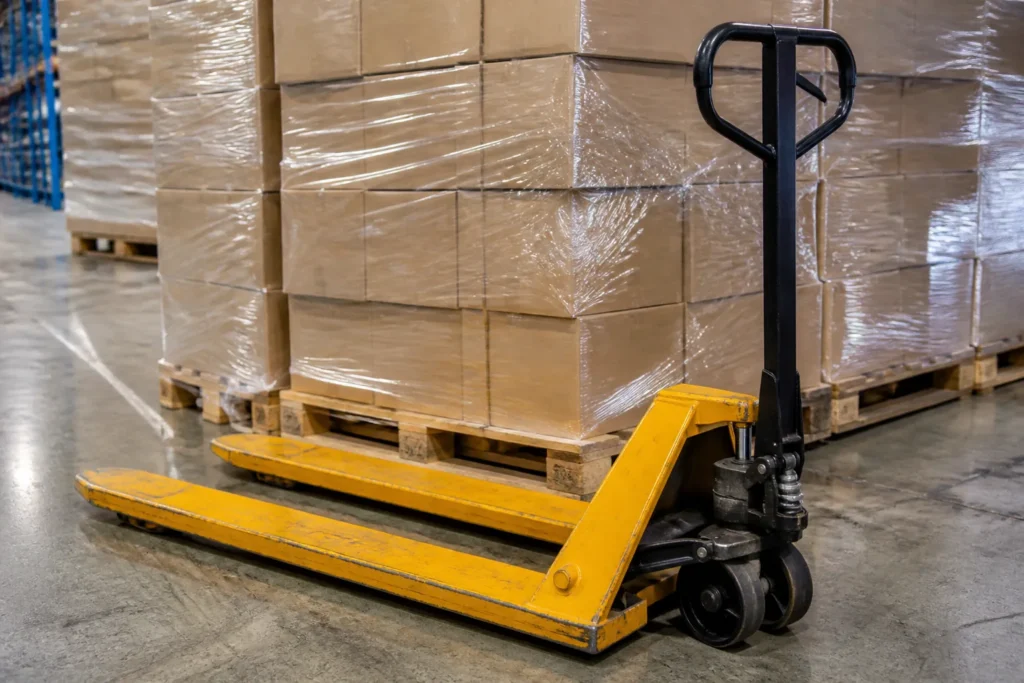
Stretch Film Pallet Stability: What Keeps a Load Together in Transit
Stretch film pallet stability is the ability of the wrap to hold cartons, bags or drums as one unit through handling, transport and storage, and it depends on containment force rather than film thickness. A stable pallet resists tipping, sliding and layer separation. Film is only one part of the system: load geometry, weight distribution and wrap pattern matter just as much. This guide helps buyers decide how to measure and improve pallet stability without over-wrapping.
1. What determines stretch film pallet stability?
Stretch film pallet stability comes from the interaction of film force, wrap pattern, load geometry and friction between layers. Film supplies the horizontal force; the pattern decides where that force is applied. A tall, narrow load needs more force at the base than a wide, low one. Assess geometry before choosing a film.
| Dimension | Impact | Buyer action / evidence |
|---|---|---|
| Containment force | Load grip | Force measurement |
| Pattern | Force distribution | Pattern review |
| Geometry | Tipping risk | Load dimensions |
2. How does containment force relate to stretch film pallet stability?
Containment force is the horizontal pressure the film exerts on the load, and it is the best single predictor of stretch film pallet stability. Force comes from film tension and the number of layers, not from gauge alone. Too little force allows movement; too much crushes cartons. Measure force at several heights rather than assuming.
| Dimension | Impact | Buyer action / evidence |
|---|---|---|
| Applied force | Load grip | Force gauge reading |
| Layer count | Force accumulation | Pass count |
| Carton strength | Crush risk | Compression review |
3. How does load settling affect stretch film pallet stability?
Load settling reduces stretch film pallet stability because cartons compress in transit and the wrap loses tension, leaving the load loose on arrival. Film with good elastic recovery keeps pulling as the load settles. Heavy stacks settle most. Allow for settling by adding base passes and checking arrival condition.
| Dimension | Impact | Buyer action / evidence |
|---|---|---|
| Settling | Loss of tension | Arrival inspection |
| Elastic recovery | Force retention | Film data |
| Stack height | Settlement amount | Load review |
4. Where does stretch film pallet stability fail in transit?
Stretch film pallet stability usually fails at the base, the top edge or a corner, because those are where forces concentrate during braking and handling. Base failure lets the load slide off the pallet; top failure lets cartons lift. Corner failure starts a tear that spreads. Inspect these three zones after every trial.
| Dimension | Impact | Buyer action / evidence |
|---|---|---|
| Base lock | Sliding risk | Post-transit photo |
| Top band | Lift risk | Edge inspection |
| Corners | Tear initiation | Corner review |
5. How does wrap pattern affect stretch film pallet stability?
Wrap pattern affects stretch film pallet stability by placing film where the load needs it, especially at the base and top. A pattern with extra base passes and a solid top band outperforms a uniform spiral of the same length. Pattern changes are cheaper than film upgrades. Test pattern before gauge.
| Dimension | Impact | Buyer action / evidence |
|---|---|---|
| Base passes | Sliding resistance | Shift test |
| Top band | Top containment | Visual standard |
| Pass distribution | Targeted strength | Pattern drawing |
6. How does film structure affect stretch film pallet stability?
Film structure affects stretch film pallet stability through elastic recovery and puncture resistance, because a wrap that tears loses all containment. Blown film resists corner damage better on rough loads. Cast film recovers smoothly and holds tension on regular cartons. Match structure to the load surface.
| Dimension | Impact | Buyer action / evidence |
|---|---|---|
| Elastic recovery | Sustained force | Recovery data |
| Puncture | Wrap integrity | Impact test |
| Surface friction | Layer grip | Slip test |
7. How should a buyer test stretch film pallet stability?
Buyers should test stretch film pallet stability with a push test, a tilt test and a real transport run, then inspect the pallet on arrival for shifted layers and lost tension. Laboratory data cannot predict a specific load. Record results per load family. Repeat after any film or pattern change.
| Dimension | Impact | Buyer action / evidence |
|---|---|---|
| Push test | Lateral resistance | Measured displacement |
| Tilt test | Tipping threshold | Angle record |
| Transit | Real-world result | Arrival report |
8. What should a buyer request before ordering for pallet stability?
Before ordering for pallet stability, buyers should provide load drawings or photos, weight and height data, and the transport route, then ask for a film and pattern recommendation with sample rolls. Confirm the supplier understands the handling profile. Trial on the worst load. Approve only after arrival inspection.
| Dimension | Impact | Buyer action / evidence |
|---|---|---|
| Load data | Correct recommendation | Drawings and weights |
| Route | Risk profile | Transit description |
| Trial result | Verified stability | Arrival inspection |
Frequently Asked Questions
Q1. Does thicker film always improve pallet stability?
Thicker film adds potential force, but stretch film pallet stability depends on applied tension, layers and pattern. A thicker film applied loosely can perform worse than a thinner film applied correctly.
Q2. What is a containment force test?
A containment force test measures the horizontal pressure the wrap exerts on the load at several heights. It is the most direct way to compare wrap settings and patterns.
Q3. Why do pallets arrive loose even when well wrapped?
Pallets arrive loose because cartons settle and compress in transit, reducing film tension. Film with good elastic recovery and extra base passes limits the effect.
Q4. Can corner boards improve stability?
Corner boards improve stability by spreading force and preventing corner punctures, and they often allow a lighter film. Compare the added labour against film savings.
Q5. Can RX Packaging support a stability trial?
RX Packaging produces cast and blown stretch film and can supply samples so buyers can test containment and arrival condition on their own worst-case loads.