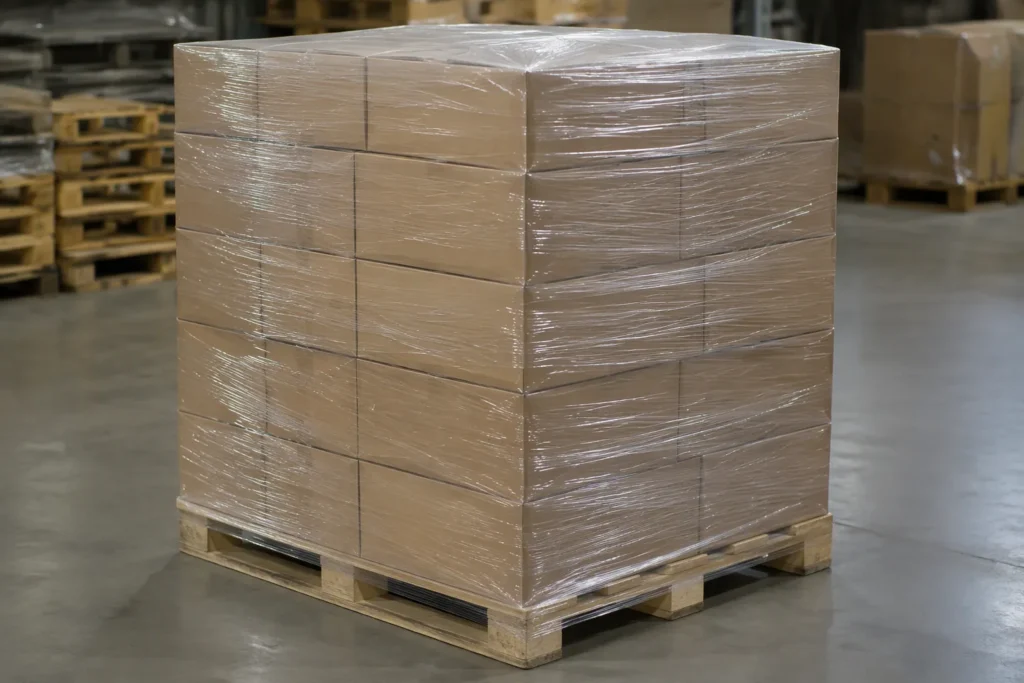
How to Reduce Stretch Film Cost Without Losing Load Stability
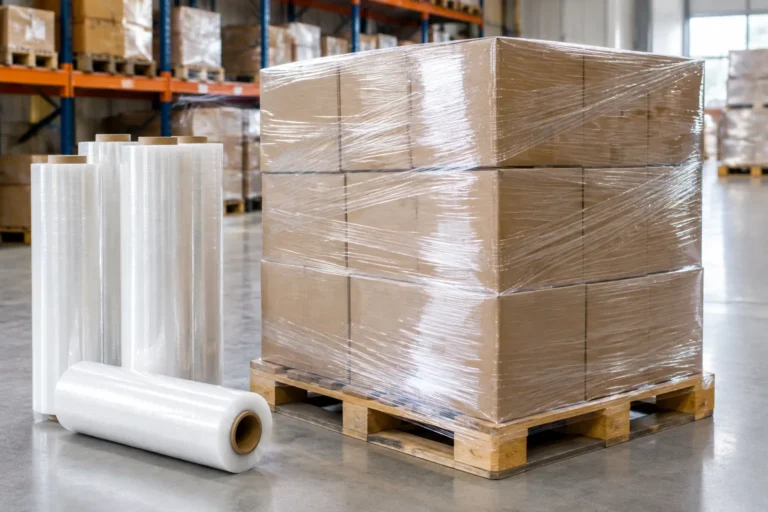
Reduce stretch film cost by attacking consumption per pallet before price per roll, because most sites overspend through over-wrapping, poor settings and the wrong roll width rather than a bad purchase price. A structured review of gauge, pre-stretch, pattern and machine condition usually finds more savings than switching supplier. The goal is containment at the lowest material cost. This guide helps buyers decide where to look first and how to prove each saving.
1. Where does stretch film cost actually come from?
Stretch film cost comes from four places: kilos consumed per pallet, price per kilo, labour and downtime, and damage from failed containment. Most buyers negotiate only the second item while the first and third are larger. Mapping the four together shows which lever is worth pulling. Build that map before requesting new quotations.
| Dimension | Impact | Buyer action / evidence |
|---|---|---|
| Consumption | Largest controllable cost | Usage per pallet data |
| Unit price | Negotiable margin | Quotation comparison |
| Downtime | Lost output | Break frequency log |
2. How does pre-stretch reduce stretch film cost?
Pre-stretch reduces stretch film cost because every extra percent of elongation turns one metre of film into more wrapped pallet, so fewer kilos leave the warehouse. Modern wrappers can apply high pre-stretch, yet many sites run conservative settings inherited from an older film grade. Increase in small steps and watch break rate. Confirm the film’s elongation limit first.
| Dimension | Impact | Buyer action / evidence |
|---|---|---|
| Pre-stretch level | Direct material saving | Wrapper setting record |
| Elongation limit | Safe ceiling | Supplier test data |
| Break rate | Hidden offset | Daily break log |
3. How does gauge selection reduce stretch film cost?
Gauge selection reduces stretch film cost when film is engineered to do the same job with less mass, but only while puncture and tear performance hold. Downgauge one step at a time with a transit test. Cutting gauge blindly shifts cost from film to damage claims. Compare delivered metres rather than roll weight.
| Dimension | Impact | Buyer action / evidence |
|---|---|---|
| Gauge step | Material saving | Staged trial plan |
| Puncture result | Damage risk | Impact test |
| Metres per roll | True unit cost | Roll label comparison |
4. How does wrap pattern reduce stretch film cost?
Wrap pattern reduces stretch film cost because unnecessary revolutions at the top and bottom consume film without adding containment. A standard pattern with a reinforced base and a single top band usually beats an operator’s habit of wrapping the full height twice. Document the pattern with photos and cycle counts. Audit compliance monthly.
| Dimension | Impact | Buyer action / evidence |
|---|---|---|
| Revolution count | Film per pallet | Cycle count record |
| Overlap percentage | Containment strength | Written standard |
| Operator habit | Variance | Pattern audit |
5. How does film width reduce stretch film cost?
Film width reduces stretch film cost by matching coverage to load height, since an oversized roll forces extra overlap and a narrow roll forces extra revolutions. The right width covers the load at the specified overlap in the fewest turns. Many sites standardise one width for convenience and pay for it on every pallet. Review your load height distribution first.
| Dimension | Impact | Buyer action / evidence |
|---|---|---|
| Width versus height | Turns required | Load height histogram |
| Overlap | Coverage efficiency | Wrap standard |
| Standardisation | Simplicity versus cost | SKU review |
6. How does machine maintenance reduce stretch film cost?
Machine maintenance reduces stretch film cost because worn rollers, misaligned brakes and dirty sensors cause inconsistent stretch, breaks and re-wraps. A wrapper that jerks or over-tensions consumes film you have already paid for. A weekly roller and setting check prevents most of it. Put maintenance on the same sheet as consumption.
| Dimension | Impact | Buyer action / evidence |
|---|---|---|
| Roller condition | Consistent stretch | Inspection checklist |
| Brake calibration | Tension accuracy | Calibration record |
| Sensor cleanliness | Cycle accuracy | Maintenance log |
7. How should a buyer prioritise actions to reduce stretch film cost?
Buyers should prioritise actions to reduce stretch film cost by estimating saving per pallet and effort, then starting with the cheapest change that touches every pallet. Settings and pattern come first because they need no capital. Gauge and width changes follow once data is stable. Price negotiation comes last, when the specification is already efficient.
| Dimension | Impact | Buyer action / evidence |
|---|---|---|
| Saving estimate | Priority order | Cost model |
| Effort | Implementation speed | Action list |
| Data stability | Reliable comparison | Baseline period |
8. What should a buyer measure to prove reduce stretch film cost results?
To prove reduce stretch film cost results, buyers should measure kilos per pallet, breaks per thousand pallets and damage rate before and after each change, over at least four weeks. Without a baseline, savings are anecdotes. Report the three numbers together so nobody trades containment for film savings. Keep the baseline visible to operators.
| Dimension | Impact | Buyer action / evidence |
|---|---|---|
| Baseline | Credible comparison | Four-week record |
| Break rate | Hidden cost | Wrapper log |
| Damage rate | Containment proof | Arrival inspection |
Frequently Asked Questions
Q1. What is the fastest way to reduce stretch film cost?
The fastest route is usually raising pre-stretch to the film’s safe limit and removing unnecessary revolutions from the pattern. Both need no capital and show results within a week.
Q2. Does cheaper film reduce cost per pallet?
Cheaper film often raises cost per pallet because lower quality causes breaks, re-wraps and damage. Compare total cost per shipped pallet, not price per roll.
Q3. How much can downgauging save?
Downgauging one step saves material in proportion to the thickness reduction, but the real saving depends on whether break and damage rates stay flat. Test before converting a line.
Q4. Does stretch film cost more in winter?
Film stiffens in cold weather and breaks more easily, which can raise consumption. Adjust tension and storage conditions rather than accepting a seasonal increase.
Q5. Can RX Packaging review my film consumption?
RX Packaging can supply cast and blown samples at different gauges so buyers can test consumption and containment on their own pallets, then choose the grade that lowers cost per pallet.