Colored Stretch Film: Using Colour as a Warehouse Coding System
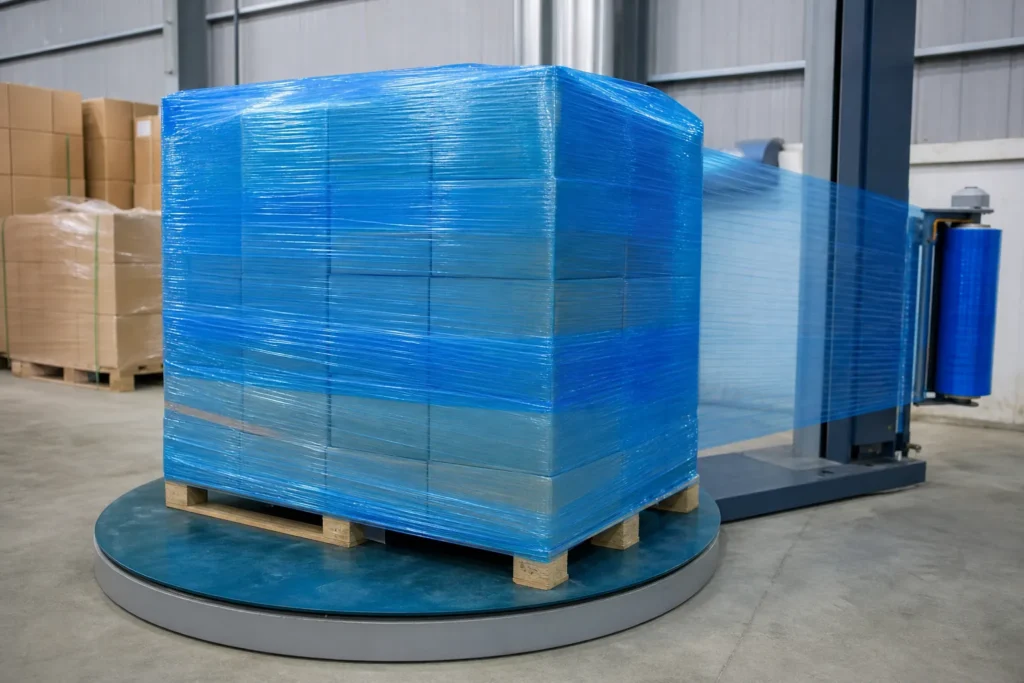
Colored stretch film is pigmented polyethylene used to code loads by customer, route, shift or status without adding labels. The colour becomes part of the wrap, so it cannot fall off in transit and stays visible in racking. Black adds opacity for discreet loads, while light shades speed up stock identification. This guide helps buyers decide which colours to standardise, how pigment affects performance and what to specify before ordering.
1. What is colored stretch film and how is the colour added?
Colored stretch film is made by adding pigment masterbatch to polyethylene before extrusion, so colour runs through the film rather than sitting on the surface. Pigment is dispersed during melting and becomes part of the polymer matrix. That means it will not rub off on cartons or hands. Ask whether the pigment is suitable for contact with packaged food.
| Dimension | Impact | Buyer action / evidence |
|---|---|---|
| Masterbatch | Consistent shade | Sample comparison |
| Dispersion | Even colour, no streaks | Roll inspection |
| Contact status | Retail and food use | Compliance declaration |
2. How does colored stretch film support warehouse coding?
Colored stretch film supports coding because colour travels with the load and stays visible after stacking, unlike a label that can be hidden or detached. A scheme of one colour per customer group or dispatch day lets pickers identify pallets without scanning. The system only works if it is documented and enforced. Publish a colour chart at every wrapping station.
| Dimension | Impact | Buyer action / evidence |
|---|---|---|
| Colour scheme | Faster identification | Documented chart |
| Station discipline | Scheme integrity | Station audit |
| Racking visibility | Picking speed | Aisle observation |
3. Which colored stretch film colours suit which purposes?
Colored stretch film colours should be assigned by function rather than preference: black for opaque or security loads, red for priority or hold, blue and green for route groups, and clear where label reading matters. Too many colours create confusion, so limit the palette to four or five. Print the mapping beside the wrapper.
| Dimension | Impact | Buyer action / evidence |
|---|---|---|
| Opacity | Load concealment | Light transmission check |
| Contrast | Reading at distance | Aisle visibility test |
| Colour count | Operator confusion | Simplified chart |
4. How does colored stretch film affect film strength?
Colored stretch film usually performs slightly below natural film at the same gauge because pigment particles interrupt the polymer structure and reduce stretch headroom. The effect is small with well-dispersed masterbatch but noticeable with heavy pigment loading. For heavy or export loads, specify a grade tested in that colour. Do not assume clear-film data applies.
| Dimension | Impact | Buyer action / evidence |
|---|---|---|
| Pigment load | Elongation loss | Grade test data |
| Dispersion quality | Weak points | Film inspection |
| Gauge compensation | Restored strength | Adjusted specification |
5. Where does colored stretch film fit in export and security work?
Colored stretch film fits export and security work because an opaque wrap conceals carton markings and makes tampering obvious, since any cut or patch breaks the colour continuity. Black film is common for high-value electronics and branded goods. Red or orange often flags inspection or customs holds. Confirm the colour resists sunlight before a long sea journey.
| Dimension | Impact | Buyer action / evidence |
|---|---|---|
| Opacity | Content privacy | Opacity sample check |
| Tamper visibility | Security assurance | Cut test on sample |
| Lightfastness | Colour fading | UV exposure data |
6. How does colored stretch film affect recycling?
Colored stretch film affects recycling because dark pigments, especially carbon black, are hard for optical sorters to detect, so coloured film often drops into lower-value streams. If you run a closed-loop programme, keep colours separate or standardise on detectable shades. Ask your recycler which colours they accept. Design the scheme with end of life in mind.
| Dimension | Impact | Buyer action / evidence |
|---|---|---|
| Pigment type | Sorting feasibility | Recycler confirmation |
| Segregation | Stream purity | Colour-separated bins |
| Recyclate value | Programme economics | Buyer agreement |
7. How should a buyer choose a colored stretch film scheme?
Buyers should choose a colored stretch film scheme by listing the decisions operators currently make with labels, then assigning colour only where it removes a step. Keep the palette small, pick high-contrast shades and test visibility under your own lighting. Involve warehouse supervisors, who know where confusion happens. Pilot on one line before company-wide rollout.
| Dimension | Impact | Buyer action / evidence |
|---|---|---|
| Decision list | Scheme scope | Process mapping |
| Lighting | Colour legibility | On-site test |
| Pilot result | Rollout confidence | One-line trial data |
8. What should a buyer request before ordering colored stretch film?
Before ordering colored stretch film, buyers should request film samples in the actual grade, a specification listing gauge, width and length, and confirmation of pigment dispersion quality. Check that the shade matches across a full roll and between batches, since colour drift is the commonest complaint. Approve a physical reference sample and keep it on file.
| Dimension | Impact | Buyer action / evidence |
|---|---|---|
| Sample medium | True colour match | Film sample approval |
| Shade consistency | Brand discipline | Batch comparison |
| Reference sample | Dispute resolution | Signed standard |
Frequently Asked Questions
Q1. Does colored stretch film cost more than clear film?
Colored film usually costs slightly more than clear film at the same gauge because of pigment and colour control. The premium is small against the labour saved by faster identification.
Q2. Can colored stretch film be recycled?
It can be recycled, but dark pigments may not be detected by automatic sorting equipment. Segregate colours or confirm acceptance with your recycler before building a programme.
Q3. Is black stretch film strong enough for heavy loads?
Black film can be strong enough if the grade is engineered for it, but heavy pigment loading can reduce elongation. Specify a grade tested in black rather than assuming clear-film data.
Q4. Will the colour rub off on my cartons?
Colour is dispersed inside the polymer, so it does not rub off like a printed coating. Poorly dispersed masterbatch can leave streaks, which is why you should inspect a full roll.
Q5. Can RX Packaging supply colour-coded film alongside standard grades?
RX Packaging produces cast and blown stretch film and can discuss colour-coded supply against your coding scheme, so request film samples in the shades you plan to standardise.