
Stretch Film Cold Storage: Choosing Film That Survives Freezers
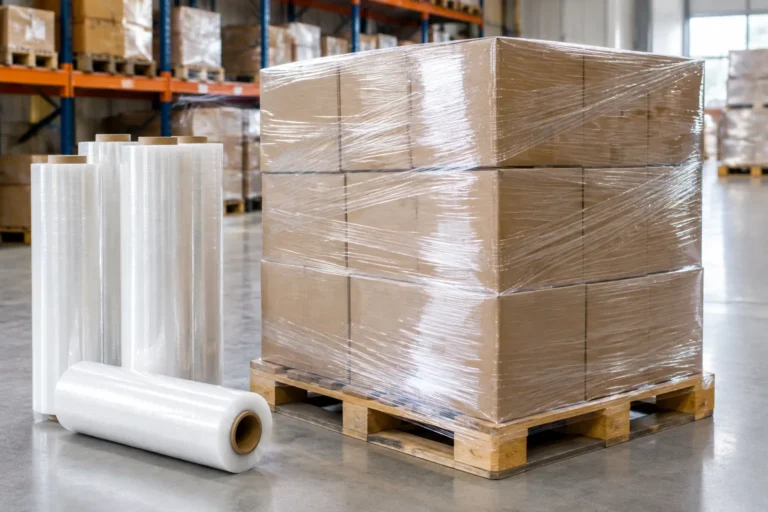
Stretch film cold storage performance depends on how polyethylene behaves at low temperature, and the short answer is that standard film stiffens, loses cling and becomes brittle below freezing, so a cold-store grade is needed. Film that wraps perfectly at ambient temperature can crack at the corners or peel open in a freezer. The fix is a combination of structure, cling chemistry and handling discipline. This guide helps buyers decide what to specify for cold storage and how to test it.
1. What happens to stretch film cold storage performance below freezing?
Stretch film cold storage performance drops below freezing because polyethylene chains lose mobility, so the film becomes stiffer and less able to absorb impact. Stiff film does not conform to carton corners, and impact energy has nowhere to go except a tear. Cast film, already less tough, suffers more than blown. Test at your real room temperature, not in an office.
| Dimension | Impact | Buyer action / evidence |
|---|---|---|
| Temperature | Flexibility | Cold room trial |
| Structure | Brittleness risk | Cast versus blown test |
| Corner contact | Tear initiation | Inspect wrapped corners |
2. How does stretch film cold storage affect cling?
Stretch film cold storage affects cling because tack additives migrate more slowly at low temperature, so layers bond weakly and tails lift. Condensation on the film surface makes it worse, since water interferes with contact between layers. Pre-warming rolls helps only briefly. Specify a cold-grade cling package and test tail hold after a shift in the freezer.
| Dimension | Impact | Buyer action / evidence |
|---|---|---|
| Cling additive | Layer bonding | Cold peel test |
| Surface moisture | Tack loss | Wipe and retest |
| Tail hold | Wrap integrity | Post-shift inspection |
3. Which structure suits stretch film cold storage, cast or blown?
Stretch film cold storage usually favours blown film because biaxial orientation gives better puncture and tear resistance when the polymer is stiff. Cast film remains easier to unwind and clearer, which matters for scanning frozen retail cartons. For very cold rooms, blown film with a cold-cling additive is the safer default. Compare both at your temperature.
| Dimension | Impact | Buyer action / evidence |
|---|---|---|
| Puncture | Corner damage | Cold impact test |
| Unwind | Operator effort | Cold wrapping trial |
| Clarity | Label scanning | Barcode read test |
4. How does stretch film cold storage change pre-stretch settings?
Stretch film cold storage changes pre-stretch because cold film has less elongation headroom, so the same setting that works at ambient temperature will break the web. Reduce pre-stretch and let the film relax before the top band. Wrapping in a cold room also affects roller grip. Record settings used at each temperature zone.
| Dimension | Impact | Buyer action / evidence |
|---|---|---|
| Elongation | Break risk | Setting trial |
| Roller temperature | Grip and slip | Maintenance check |
| Zone differences | Inconsistent wrap | Zone setting sheet |
5. Where does stretch film cold storage fit in frozen food and pharma?
Stretch film cold storage fits frozen food, chilled distribution and pharmaceutical cold chain, where loads move between temperature zones and condensation is constant. Film must hold through freeze-thaw cycles without losing containment. Pharma loads often need clean unwind and low noise in enclosed areas. Map the temperature path of each lane before specifying.
| Dimension | Impact | Buyer action / evidence |
|---|---|---|
| Temperature path | Film stress | Lane mapping |
| Condensation | Cling loss | Moisture trial |
| Cleanliness | Contamination risk | Unwind inspection |
6. How should stretch film cold storage rolls be handled before wrapping?
Stretch film cold storage rolls should be conditioned before use, because film taken straight from a cold dock is stiff and condensates when moved into a warmer area. Store rolls in the wrapping area at the temperature where they will be applied, and avoid opening cartons early. Keep rolls off concrete floors. Rotate stock so older rolls are used first.
| Dimension | Impact | Buyer action / evidence |
|---|---|---|
| Conditioning | Flexibility at application | Storage location check |
| Condensation | Cling and print damage | Wrapped sample inspection |
| Stock age | Cling degradation | Batch date control |
7. How should a buyer test stretch film cold storage performance?
Buyers should test stretch film cold storage performance by wrapping pallets inside the actual cold room, then dropping or handling one pallet and inspecting corners and tails after twenty-four hours. Ambient trials tell you nothing about freezer behaviour. Record breaks per pallet and tail failures. Repeat with a second structure before deciding.
| Dimension | Impact | Buyer action / evidence |
|---|---|---|
| Test location | Real behaviour | Cold room trial |
| Handling test | Impact resistance | Drop and corner check |
| Time delay | Cling development | Twenty-four hour review |
8. What should a buyer request before ordering stretch film cold storage grade?
Before ordering a stretch film cold storage grade, buyers should state the operating temperature range, the structure preferred, the cling requirement and the handling profile, then request samples produced for that range. Ask how the grade differs from standard film. Confirm gauge and roll length match your wrapper. Approve a retained sample for future batches.
| Dimension | Impact | Buyer action / evidence |
|---|---|---|
| Temperature range | Grade selection | Written brief |
| Grade difference | Performance proof | Supplier explanation |
| Approved sample | Batch reference | Retained sample |
Frequently Asked Questions
Q1. Can normal stretch film be used in a freezer?
Normal stretch film can be applied in a freezer but usually cracks at corners and loses cling quickly, so stretch film cold storage performance depends on grade. A cold-grade film with appropriate structure and additives performs far better.
Q2. Does stretch film lose strength when frozen?
Stretch film does not lose tensile strength when frozen, but it loses flexibility and impact resistance, so it fails at corners rather than in the web. That is why puncture behaviour matters more than tensile data.
Q3. Should cold storage film be thicker?
A thicker film can compensate for reduced flexibility, but structure and cling chemistry matter more than gauge alone. Test a blown grade at your current gauge before increasing thickness.
Q4. Why do wraps open in the freezer?
Wraps open because cling additives work slowly in cold conditions and condensation prevents layer contact. A cold-grade cling package plus a longer tail overlap solves most cases.
Q5. Can RX Packaging supply film for cold storage trials?
RX Packaging produces cast and blown stretch film and can supply samples for cold-room trials, so buyers can test both structures at their own operating temperature before ordering.