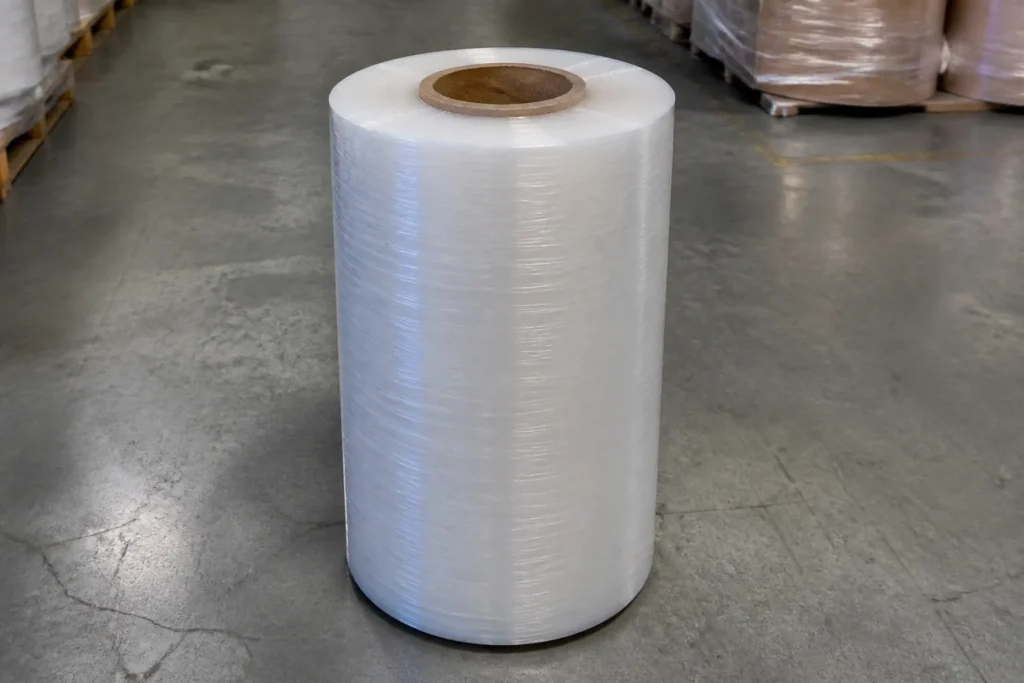
Stretch Film Clarity: When Visibility Is Worth Paying For
Stretch film clarity is the optical transparency of the film, and it matters when barcodes, labels or product appearance must be read through the wrap. Clear film usually costs more than hazy film at the same gauge because it needs tighter process control. Not every load needs it. This guide helps buyers decide which loads genuinely require clarity, how clarity interacts with gauge and structure, and how to balance visibility against cost per pallet.
1. What determines stretch film clarity?
Stretch film clarity depends on how evenly the polymer cools and crystallises, because uneven cooling scatters light and creates haze. Cast film cools on a polished roller, which produces a smooth surface and high transparency. Blown film cools in air, so it usually shows more haze. Resin grade and additive choice also affect transparency. Ask for a haze value rather than a description.
| Dimension | Impact | Buyer action / evidence |
|---|---|---|
| Cooling method | Surface smoothness | Production method |
| Crystallinity | Light scattering | Haze measurement |
| Additives | Cloudiness | Formulation details |
2. How does cast vs blown film affect stretch film clarity?
Stretch film clarity is noticeably better in cast film because the chill roller produces a flat, glossy surface that transmits light evenly. Blown film has a slightly rougher surface from the air bubble, so it looks hazier even when thin. That is one reason cast film dominates retail and label-sensitive applications. Compare samples over printed cartons, not on a white wall.
| Dimension | Impact | Buyer action / evidence |
|---|---|---|
| Surface finish | Gloss and haze | Visual sample check |
| Print visibility | Label readability | Sample over print |
| Structure cost | Price difference | Quotation comparison |
3. How does stretch film clarity affect scanning and inspection?
Stretch film clarity affects scanning because a hazy or wrinkled wrap can stop a barcode reader, forcing manual entry and slowing dispatch. It also affects visual inspection, since operators cannot see damage or labels through opaque film. Clear film reduces those interruptions on automated lines. Test scanning through the actual film on your conveyor.
| Dimension | Impact | Buyer action / evidence |
|---|---|---|
| Haze level | Read rate | Scan trial |
| Wrinkle pattern | Reader errors | Wrap quality check |
| Label contrast | Inspection speed | Operator feedback |
4. Which loads actually need stretch film clarity?
Stretch film clarity is only worth paying for on loads where someone must read through the film: retail-ready cartons, barcoded cases, pharmaceutical packs and branded goods. Industrial loads with plain cartons gain nothing from clarity. Segment your loads before specifying one grade for everything. Most warehouses need clear film on a minority of pallets.
| Dimension | Impact | Buyer action / evidence |
|---|---|---|
| Label dependence | Clarity requirement | Label audit |
| Customer expectation | Presentation | Customer specification |
| Load mix | Grade split | Volume by family |
5. How does gauge affect stretch film clarity?
Gauge affects stretch film clarity because thicker film transmits slightly less light and shows more surface distortion, while very thin film can look clearer but wrinkles more easily. The relationship is not linear, and a well-made thin cast film often looks better than a thick blown film. Judge clarity at the gauge you will actually run. Do not assume thicker means clearer.
| Dimension | Impact | Buyer action / evidence |
|---|---|---|
| Gauge | Light transmission | Sample at target gauge |
| Wrinkle tendency | Visual noise | Wrapped pallet check |
| Surface quality | Gloss level | Roll inspection |
6. How should a buyer compare stretch film clarity between suppliers?
Buyers should compare stretch film clarity by wrapping identical printed cartons with each sample and viewing them under the same lighting from a normal working distance. Photographs taken in different light prove nothing. Ask each supplier for a haze value and check whether it is measured or estimated. Keep a reference pallet for future batches.
| Dimension | Impact | Buyer action / evidence |
|---|---|---|
| Test setup | Fair comparison | Standard photo setup |
| Haze data | Objective ranking | Measured value |
| Reference pallet | Batch control | Retained sample |
7. How should a buyer balance stretch film clarity against cost?
Buyers should balance stretch film clarity against cost by calculating the cost of poor visibility, including manual scanning, mispicks and customer complaints, then comparing it with the clarity premium. On most industrial loads the premium buys nothing. On retail loads it usually pays back quickly. Split the specification by load family rather than buying one grade.
| Dimension | Impact | Buyer action / evidence |
|---|---|---|
| Visibility cost | Justifies premium | Delay and error data |
| Film premium | Added spend | Price comparison |
| Load split | Targeted spend | Family volumes |
8. What should a buyer request before ordering film for clarity?
Before ordering film for clarity, buyers should request samples of both structures, a haze value, and a wrapped carton photographed under their own lighting. Confirm the grade is stable batch to batch, because clarity drifts when cooling conditions change. Ask how the supplier controls surface quality. Approve a reference sample in writing.
| Dimension | Impact | Buyer action / evidence |
|---|---|---|
| Samples | Real appearance | Wrapped carton test |
| Haze value | Objective comparison | Supplier data |
| Batch stability | Consistent presentation | Historical records |
Frequently Asked Questions
Q1. Is clear stretch film stronger than coloured film?
Stretch film clarity and strength are separate issues: clear film usually has slightly better elongation than heavily pigmented film because pigment interrupts the polymer structure. Strength differences are small compared with structure and gauge.
Q2. Why does my clear film look cloudy on the pallet?
Cloudiness on the pallet usually comes from wrinkle patterns, condensation or over-stretching rather than the film itself. Check wrap tension and storage conditions before changing grade.
Q3. Does clarity affect stretch film price much?
Clear film carries a modest premium over hazy film at the same gauge because it needs tighter process control. The premium is small next to the cost of manual scanning.
Q4. Can blown film be clear enough for barcodes?
Well-made blown film can be clear enough for many barcode applications, especially at thin gauges. Test scanning through the actual film rather than judging by eye.
Q5. Can RX Packaging supply clear cast film samples?
RX Packaging produces cast and blown stretch film, and cast grades are the usual choice where clarity matters, so request samples and compare them over your own printed cartons.