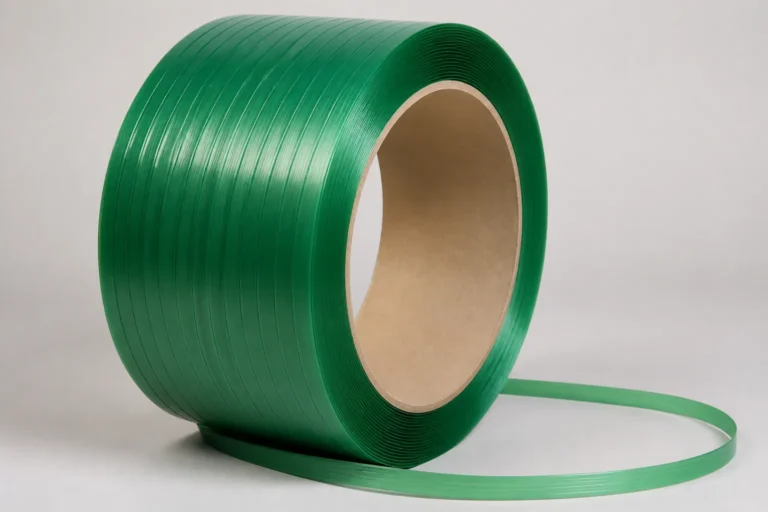

Strapping Material Comparison: PP, PET and What Fits Your Load
A strapping material comparison should weigh strength, stretch, cost, climate and tooling together, because no polymer wins on every measure. PP is elastic and economical; PET is strong and holds tension. Most plants need both somewhere. This guide helps buyers compare materials on the criteria that decide real pallet performance rather than catalogue numbers.
1. What does a strapping material comparison need to cover?
A strapping material comparison needs to cover load behaviour, climate, tooling, cost per pallet and supply reliability. Strength is only one line in the table, because a strong band that relaxes or jams still fails. Compare materials on the full cycle from packing line to customer.
Build the comparison around your real loads and routes.
| Dimension | Impact | Buyer action / evidence |
|---|---|---|
| Load profile | Material suitability | Weigh and photograph ten pallets |
| Climate | Relaxation and brittleness | Log temperature extremes |
| Cost basis | Real budget | Compare per secured pallet |
2. How do PP and PET compare on strength in a strapping material comparison?
PP and PET compare very differently on strength and stretch. PP stretches well before reaching working tension, so it cushions compressible loads but loses tension as they settle. PET reaches high tension with little stretch and resists creep. That makes PET better for rigid, heavy or long-stored loads.
Compare retained tension, not just break strength.
| Dimension | Impact | Buyer action / evidence |
|---|---|---|
| Elongation | Load settling behaviour | Request elongation data |
| Break strength | Shock margin | Compare at equal width |
| Creep | Tension after days | Ask for retention results |
3. How do PP and PET compare on cost in a strapping material comparison?
PP and PET compare on cost through price per coil and cost per secured pallet, which are not the same. PP is usually cheaper per kilo, but higher consumption or extra straps can erase the difference. Supply also matters: confirm both polymers are consistently available in your widths before standardising.
Compare total cost per pallet, including failures and labour.
| Dimension | Impact | Buyer action / evidence |
|---|---|---|
| Unit price | Visible cost | Request quotes for equal widths |
| Consumption | Real material cost | Weigh usage per hundred pallets |
| Lead time | Stock planning | Confirm repeat order lead times |
4. Which material suits which load in a strapping material comparison?
In a strapping material comparison, load type usually decides the winner. Light cartons, short routes and manual benches favour PP. Heavy, rigid, sharp or long-stored loads favour PET. Mixed portfolios often end with PP for internal cartons and PET for export and heavy goods.
Map material to load band before comparing prices.
| Dimension | Impact | Buyer action / evidence |
|---|---|---|
| Load weight | Material class | Sort SKUs into bands |
| Transit length | Retention need | Measure days in transit |
| Edge sharpness | Cut risk | Inspect contact points |
5. How should a buyer run a strapping material comparison?
Running a strapping material comparison means testing both materials on identical loads. Strap the same product with PP and PET, then handle and store both pallets the same way. Check tension after a day and a week, and record any crush, slip or break. Only then compare cost.
Run both materials side by side on the same SKU.
| Dimension | Impact | Buyer action / evidence |
|---|---|---|
| Test symmetry | Fair comparison | Use identical pallets |
| Duration | Reveals creep | Check at 24 hours and 7 days |
| Record quality | Decision evidence | Photograph both results |
6. What should you check on samples in a strapping material comparison?
Sample checks in a material comparison should cover surface, edges, camber and seal behaviour for both materials. Then run a full coil through your actual tool, because feed problems only appear over hundreds of metres. A sample that tensions well by hand can still jam in a machine.
Run a full coil of each material through your tool or machine.
| Dimension | Impact | Buyer action / evidence |
|---|---|---|
| Feed reliability | Machine uptime | Run a full coil of each |
| Seal quality | Joint strength | Pull-test ten seals per material |
| Coil winding | Jams and waste | Check winding tension |
7. How does climate change a strapping material comparison?
Climate changes a strapping material comparison because heat and cold affect the polymers differently. Heat accelerates PP relaxation, so a band that works in a mild warehouse loosens in a hot container. Cold makes PP brittle, while PET keeps more toughness. Compare materials at your real extremes.
Add a temperature trial to every material comparison.
| Dimension | Impact | Buyer action / evidence |
|---|---|---|
| Shipping climate | Material ranking | Test at container temperatures |
| Storage climate | Long-term retention | Log warehouse peaks |
| Seasonal claims | Confirms the pattern | Compare claims by month |
8. Should you standardise on one material in a strapping material comparison?
Standardising on one material or mixing depends on your SKU spread. A single polymer simplifies buying, training and stock, but over-specifies light loads and under-serves heavy ones. Two polymers with clear rules usually cost less overall and perform better.
Standardise where loads are similar, mix where they are not.
| Dimension | Impact | Buyer action / evidence |
|---|---|---|
| SKU spread | Material range | Group by weight and route |
| Operator clarity | Wrong band risk | Use colour and labels |
| Inventory | Cash in coils | Limit widths per polymer |
Q1. Is PET always stronger than PP?
PET generally carries higher tension with less stretch, but strength depends on width and gauge. A wide PP band can outperform a narrow PET band, so compare at equal dimensions.
Q2. Which material is cheaper per pallet?
PP is usually cheaper per kilo, yet consumption, extra straps and failures change the answer. Calculate cost per secured pallet for each material on the same load.
Q3. Can I switch materials without changing tools?
Not always. PET needs a stronger tensioner and a matched seal, so check tool ratings before switching. A full coil trial reveals feed problems early.
Q4. Which material suits cold storage?
PET keeps more toughness and tension in the cold, while PP becomes brittle and relaxes. For freezer and winter routes, PET is usually the safer choice.
Q5. What should I request before deciding?
Request samples of both polymers in your widths, a side-by-side pallet trial and retention data. RX Packaging supplies SGS-certified PP and PET band with 12-point quality results.