Stretch Film Cling: Why Film Sticks, Why It Fails and What to Specify
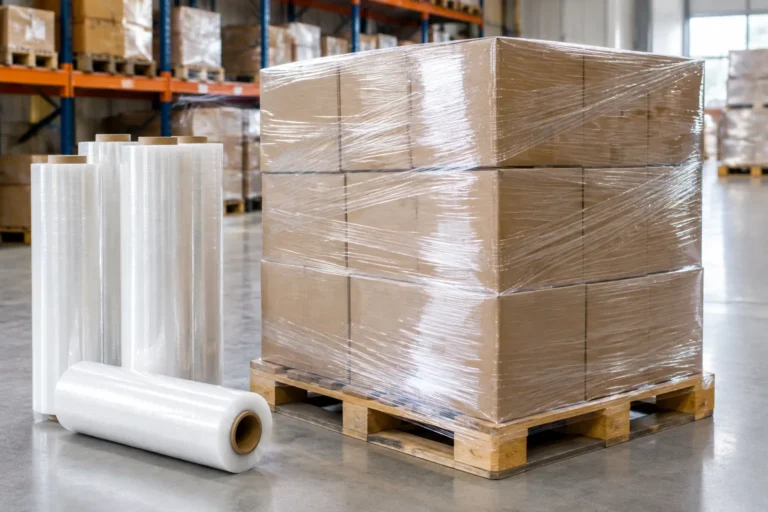
Stretch film cling is the tack that makes film adhere to itself, produced by cling additives migrating to the surface and activated by pressure during wrapping. Cling holds the tail down, bonds layers and stops the spiral unwinding in transit. Too little causes loose tails and open wraps; too much makes rolls hard to unwind and pallets hard to open. This guide helps buyers decide which cling level and side configuration suits their equipment and climate.
1. What causes stretch film cling?
Stretch film cling comes from low-molecular-weight additives, often called tackifiers, that migrate to the film surface and form a light bond when two layers touch under pressure. The bond is temporary and mechanical rather than adhesive, so it releases cleanly when pulled apart. Temperature and stretch both change how fast the additive works. Ask whether cling is one-sided or two-sided.
| Dimension | Impact | Buyer action / evidence |
|---|---|---|
| Additive type | Cling strength | Supplier declaration |
| Surface migration | Cling over time | Aged roll test |
| Pressure | Layer bonding | Wrap tension check |
2. How does one-sided versus two-sided stretch film cling differ?
One-sided cling means only the inside of the roll is tacky, so film sticks to itself on the pallet but not to machine rollers or the outer face. Two-sided cling sticks in both directions and is common on hand film, where instant tack matters. Machine film is usually one-sided to avoid roller build-up. Match the configuration to your equipment.
| Dimension | Impact | Buyer action / evidence |
|---|---|---|
| Side configuration | Equipment compatibility | Roll spec check |
| Roller build-up | Machine downtime | Cleaning frequency |
| Tail hold | Wrap integrity | Trial inspection |
3. How does temperature affect stretch film cling?
Temperature affects stretch film cling because additives migrate faster when warm and much slower when cold, so film that performs in summer can fail in a cold store. Cold film also stiffens, reducing contact area between layers. Winter and freezer applications need a grade formulated for low temperature. Test cling at the temperature you actually wrap in.
| Dimension | Impact | Buyer action / evidence |
|---|---|---|
| Ambient temperature | Cling speed | On-site trial |
| Cold store use | Tail failure risk | Cold room test |
| Seasonal drift | Inconsistent quality | Seasonal review |
4. How does stretch film cling affect machine performance?
Stretch film cling affects machine performance because cling that is too high drags on pre-stretch rollers, raising unwind force and causing web breaks or uneven stretch. Cling that is too low lets film slip and lose tension between rollers. Both show up as inconsistent wrap quality. Watch the unwind section during a full-speed run.
| Dimension | Impact | Buyer action / evidence |
|---|---|---|
| Unwind force | Motor load, break risk | Wrapper current reading |
| Roller slip | Stretch accuracy | Visual run check |
| Wrap tension | Containment | Force measurement |
5. Where does stretch film cling matter most in the wrap pattern?
Stretch film cling matters most at the start and end of the wrap, where the tail must anchor to the load and to itself, and at the top and bottom bands, where layers must stay bonded. A pallet can look well wrapped yet fail because the last metre lifted. Reinforce the tail with a short overlap and check it after handling. Photograph a good tail for the standard.
| Dimension | Impact | Buyer action / evidence |
|---|---|---|
| Tail length | Unwind risk | Post-handling inspection |
| Top band | Load integrity | Photo standard |
| Bottom lock | Base stability | Wrap audit |
6. How does stretch film cling change with storage and ageing?
Stretch film cling changes with storage and ageing because additives keep migrating, so a roll stored warm for months becomes tackier on the surface and blocks more easily, while a cold roll may underperform. Very old rolls can lose cling as additives oxidise. Rotate stock and store rolls away from heat. Use older rolls first.
| Dimension | Impact | Buyer action / evidence |
|---|---|---|
| Storage temperature | Blocking and drift | Store away from heat |
| Age | Performance loss | Batch date control |
| Stock rotation | Consistent supply | First-in first-out |
7. How should a buyer test stretch film cling before ordering?
Buyers should test stretch film cling by wrapping a real pallet, pulling the tail and lifting a layer by hand to judge resistance, then checking whether the wrap stays closed after a shift. A simple peel test between two layers gives a comparative number. Test at your real temperature with your real equipment. Keep notes so grades stay comparable.
| Dimension | Impact | Buyer action / evidence |
|---|---|---|
| Peel force | Comparative cling | Simple peel test |
| Tail hold | Practical performance | Handling trial |
| Temperature | Real-world behaviour | On-site conditions |
8. What should a buyer specify about stretch film cling?
Buyers should specify whether cling is one-sided or two-sided, the application temperature and the equipment type, then ask the supplier to confirm the grade matches. Cling is rarely printed on a quotation, which is why failures recur. Write it into the purchase specification and reference a sample. Review the specification when seasons change.
| Dimension | Impact | Buyer action / evidence |
|---|---|---|
| Cling side | Machine compatibility | Written specification |
| Temperature range | Seasonal reliability | Application declaration |
| Approved sample | Dispute reference | Retained sample |
Frequently Asked Questions
Q1. Why is my stretch film not sticking to itself?
Stretch film cling may fail if the additive is low, if the film is cold, or if dust and carton fibre have contaminated the surface. Check storage temperature and try a fresh roll first.
Q2. Is two-sided cling better than one-sided?
Neither is better in general: two-sided cling suits hand wrapping, while one-sided cling suits machines because it reduces build-up on rollers. Choose by equipment.
Q3. Can I add cling to film that has lost tack?
Cling cannot be restored reliably once the additive has degraded or the surface is contaminated. Replace the roll and review storage conditions instead of treating the film.
Q4. Does cling affect how easily a pallet is opened?
Higher cling makes layers harder to separate at receiving, which slows unloading. If customers complain about difficult opening, specify moderate cling rather than maximum tack.
Q5. Can RX Packaging match cling to my wrapping method?
RX Packaging produces cast and blown stretch film for hand and machine use, so buyers can request samples with the cling configuration that matches their equipment and test them on real pallets.